A lot of the fuel tank jobs that come into our Surrey shop start the same way. The owner says, “I keep smelling gas in the bilge,” or, “The gauge has been acting up since last season.” Sometimes it’s a buyer who just had a survey done on a used boat, and the surveyor circled the fuel tank in red.
If that sounds like you, this guide covers what we look for, when a tank can be repaired, when it really should be replaced, and what goes into building a custom aluminum fuel or water tank that actually fits your boat. It’s based on the tank work we do at Cedric Marina for pleasure boats, fishing boats and work boats across Vancouver and the Lower Mainland.
Signs Your Boat Fuel Tank Needs Attention
Fuel tanks usually fail slowly and out of sight. Most of them sit under a deck or a cockpit sole, so by the time you see a problem, it has often been going on for a while. These are the warning signs we hear about most:
- A fuel smell in the bilge or cabin, especially after filling up or on a warm day.
- A sheen on the bilge water or fuel staining around the tank area.
- Weeping at a seam, a fitting or the sending unit. Dampness around the top of the tank is often the first thing an owner notices when a hatch is opened.
- White, powdery corrosion or pitting on an aluminum tank, particularly on the bottom and where the tank touches its supports.
- Water in the fuel, a clogged fuel filter or an engine that runs rough, which can point to a failing vent, fill or tank.
- A tank that was flagged in a marine survey when buying or insuring a used boat.
A fuel leak is not something to leave until the end of the season. If you smell gas, keep the boat ventilated, don’t run anything that could spark in that space, and have the tank looked at before you use the boat again.

Why Aluminum Tanks Corrode, and Why It’s Usually Not the Metal’s Fault
Marine-grade aluminum is a great material for fuel and water tanks. It’s light, strong and handles fuel well. When an aluminum tank fails early, it’s almost always because of how it was installed, not the aluminum itself.
The most common problem we see is trapped water. On many older production boats, the tank was set in place and then foamed in, or it sits on pads or straps that hold moisture against the metal. Salt water and rain get into that space and never dry out. Over years, the aluminum pits from the outside until it weeps. From above, the tank can look perfect.
Other causes we run into:
- Contact with dissimilar metals, like steel straps, copper or stainless fasteners, without proper isolation.
- Chafe where the tank rubs on a stringer, a bracket or a hose clamp as the boat pounds.
- Flexing from missing baffles or poor support, which can crack welds over time. Our article on weld cracking explains why welds fail under repeated stress.
This is why, when we build a replacement, how the tank is supported and kept dry in the boat matters as much as the tank itself.
Repair or Replace?
We’re asked this on almost every tank job. The honest answer depends on where the damage is and what the rest of the tank looks like.
A repair can make sense when
- The leak is at a fitting, the sending unit gasket or a single weld, and the rest of the tank is sound.
- The tank is easy to remove and the damage is small and local, like a crack from a bracket.
- After cleaning, the metal around the problem is still a good thickness.
Replacement is usually the better call when
- There’s pitting in more than one place, especially along the bottom.
- The tank has been foamed in and is corroded from the outside. If one spot is leaking, others are often close behind.
- The tank has already been patched before.
- You want to change the capacity, add a second tank, or move a fill or vent while the deck is open anyway.
Welding onto a tank that has held fuel is specialized work. It has to be fully emptied, cleaned and made safe first, and then the repair has to be tested like a new tank. It’s not a job for a quick patch.
What Goes Into a Custom Aluminum Tank
Most of the boats we see are not getting an off-the-shelf tank. Older boats, custom boats and work boats rarely have a replacement available, and even when they do, the shape often doesn’t match the space. That’s why we build tanks to order at our custom marine fuel and water tank shop.
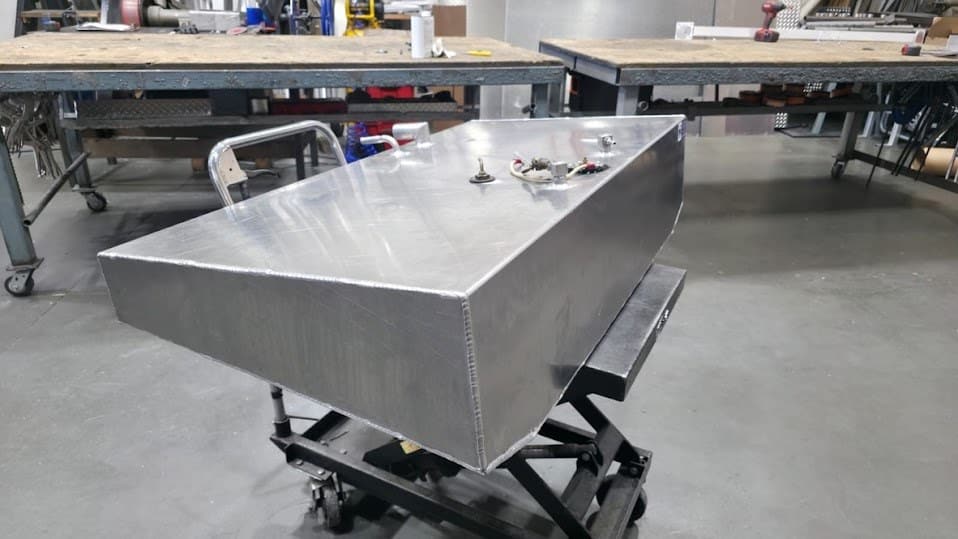
Here’s what we work through on a typical build:
- Measuring the space. We measure the old tank and, more importantly, the space it lives in. Hull shape, stringers and hatch openings decide the final shape, and the new tank has to go in through the same opening the old one came out of.
- Capacity. Some owners want the same capacity. Others want more range, or want to split one large tank into two. We plan the shape around what you actually use the boat for.
- Fittings. The fill, vent, pickup, return and sending unit are placed where they suit your boat, not where a generic tank puts them. Moving a fitting a few inches can make hoses shorter and much easier to service.
- Baffles. Larger tanks get internal baffles to reduce fuel sloshing and add stiffness.
- Welding. We TIG weld our tanks from marine-grade aluminum. Clean, fully fused seams are what keep a tank from weeping years later.
- Pressure testing. Every tank is pressure tested and checked before it leaves the shop.
- Installation. The tank is set on supports that let water drain away, isolated from other metals and secured so it can’t move. We don’t want the new tank to fail for the same reason the old one did.

Fresh Water Tanks Too
Everything above applies to fresh water tanks as well. Leaking water tanks are a common reason for soft floors and damp cabins, and many older boats have tanks that simply don’t fit a new layout. We build aluminum water tanks to fit the space, with the fittings where your plumbing needs them. If you’re replacing a pump or reworking lines at the same time, our introduction to boat plumbing is a good place to start.
What It Costs, and What Changes the Price
Every custom tank is quoted individually, because no two jobs are the same. The things that affect the price most are:
- The size and shape of the tank. Simple boxes cost less than tanks shaped to a hull.
- The number of fittings and baffles.
- How hard the old tank is to get out. A tank under a bolted hatch is a very different job from one under a glassed-in deck.
- Whether the old tank was foamed in and needs to be cut out.
- Any extra work once the tank is out, like new supports, hoses or deck repairs.
If you’re looking at a used boat, it’s worth asking about the tank before you buy. We cover more of that in our guide to buying a secondhand aluminum boat and in the real costs of owning a boat.
Quick Answers
How long does an aluminum fuel tank last?
A well-built and properly installed aluminum tank can last many years. The ones that fail early are usually sitting in trapped water or touching other metals.
Can you copy my old tank exactly?
Yes. We can match the old tank, or improve on it by changing the capacity, the fitting locations or the supports.
Do I need to bring the boat to you?
Many tanks are built at our Surrey facility from the old tank or from measurements. For some jobs, our mobile welding service can handle work where the boat sits.
Can you fix other damage while the tank is out?
Yes. Once the deck is open, it’s a good time to look at stringers, brackets and other structure. Our marine repair team can take care of it in the same visit.
Talk to Cedric Marina About Your Tank
Cedric Marina has been building and repairing marine metalwork since 2015, from a Surrey facility that serves Vancouver, Coquitlam and the rest of the Lower Mainland. Our owners have given us a 5.0 rating on Google across more than 60 reviews, and you can read what they say on our reviews page.
Send us photos of your tank and the space it sits in, the make and model of your boat, and what’s going on. You can reach us through our contact page or call (604) 505-8181. We’ll tell you honestly whether it’s a repair or a replacement, and what a custom tank would take.